
Can Non-Surgical Facelift Treatments Replace Surgery? Methods, Limits and Risks
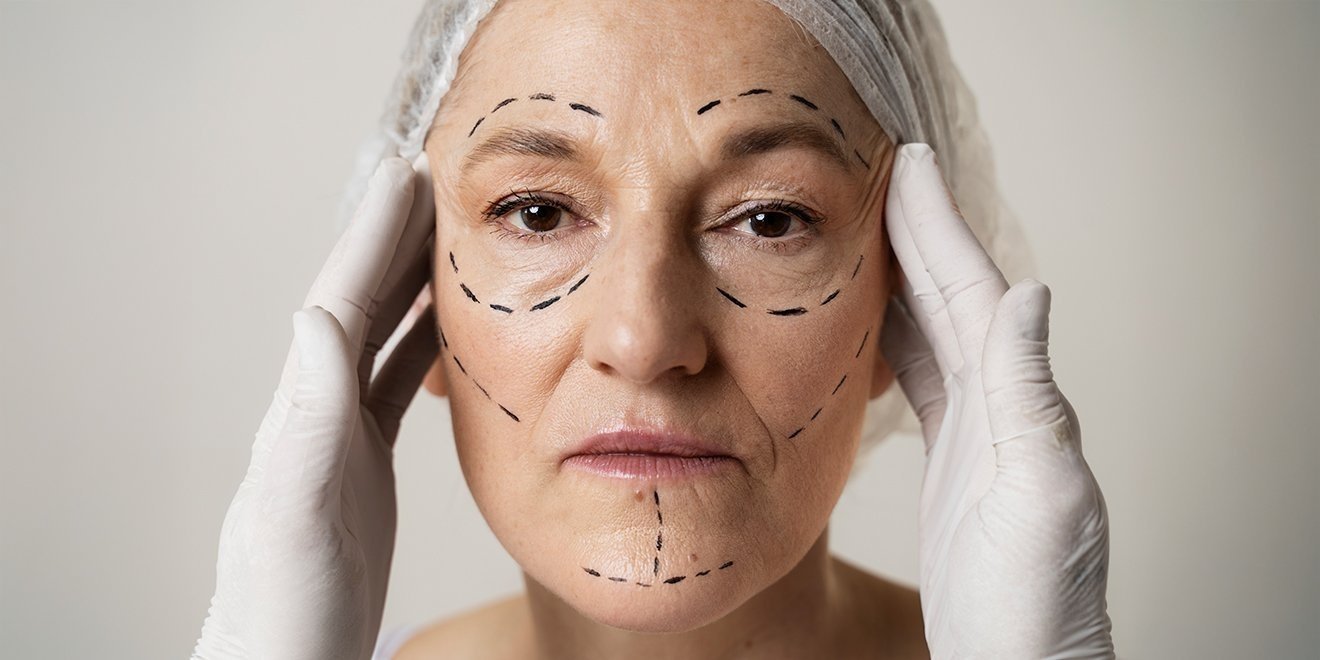
Non-surgical facelift treatments (such as thread lifts, focused ultrasound, radiofrequency and fillers) can improve skin quality and mild laxity, but they cannot reposition the deeper tissues that have descended or remove excess skin. For this reason, they do not replace a facelift when sagging is marked; their effects are temporary and may need to be repeated. Which option suits you is decided at consultation, based on the degree of sagging and your skin quality.
What is a non-surgical facelift?
"Non-surgical facelift" is an umbrella term for treatments performed without incisions that aim to tighten the skin, lift tissue slightly or restore lost volume. Although the word "facelift" is used, these treatments work differently from a surgical facelift. Ageing affects several layers of the face together: the skin, fat, the SMAS (a fibrous support layer beneath the skin that connects the muscles and fat), the retaining ligaments and bone support. Non-surgical treatments mainly act on skin quality and volume; they cannot reposition the SMAS and retaining ligaments, and they cannot remove excess skin.
What are the non-surgical options, and what can they do?
Non-surgical treatments can improve skin quality and mild laxity, but when sagging is marked they cannot reposition the deeper tissue or remove excess skin. They are useful in the right patient, but they do not do what surgery does.
| Method | What it targets | Its limits | How long it lasts |
|---|---|---|---|
| Thread lift (dissolvable or barbed threads) | Lifting superficial tissue slightly by mechanical support; stimulating some collagen production | Cannot carry the SMAS or remove excess skin; in heavy skin it can cause puckering or dimpling | Temporary |
| Focused ultrasound (HIFU) | Tightening by stimulating collagen production with heat | Tightens but does not lift; limited effect on marked jowls and neck bands | Temporary, needs repeating |
| Radiofrequency (microneedling or non-needle) | Collagen production in the middle layer of the skin (dermis), fine lines and skin quality | No meaningful lifting effect on sagging | Temporary, needs repeating |
| Fillers ("liquid facelift") | Replacing lost volume in areas such as the cheekbones and jawline | Cannot lift sagging skin; if overused to camouflage sagging, an unnatural, overfilled look can result | Temporary, depends on the product |
| Botox | Softening expression lines by temporarily relaxing facial muscles | Does not lift sagging or remove excess skin | Temporary, needs repeating |
| Facial fat injection | Replacing volume loss in the cheeks, temples and jawline with your own fat | A minor surgical procedure, because fat must be taken from another area of the body; does not lift sagging skin | Part of the transferred fat settles and part is absorbed; the proportion varies from person to person |
Fillers and facial fat injection for volume, and botox for expression lines, can each be considered separately. In the right patient, these treatments can also be planned alongside a facelift. For an overview of these treatments, see our non-surgical aesthetics page.
Why are non-surgical treatments not enough for marked sagging?
When sagging is marked, the problem is not only looser skin: the cheek tissues and SMAS have descended, the retaining ligaments have loosened and excess skin has formed. A facelift moves these deeper tissues back into position and removes the extra skin without creating tension. Non-surgical treatments do not reach the deeper tissue: a thread lift suspends superficial tissue to a limited degree, focused ultrasound and radiofrequency tighten but do not lift, and fillers add volume but do not move sagging skin upwards.
Using too much filler to camouflage sagging can create an unnatural, heavy appearance, and placing threads in heavy skin can lead to puckering or dimpling. For the difference between surgical techniques, see deep plane vs SMAS facelift.
Which approach may suit which situation?
The decision is based not on age but on the degree of sagging, skin quality and the patient's expectations. The scenarios below are a general guide:
- No significant sagging; skin quality and fine lines are the main concern: surgery is usually not needed. Energy-based treatments that improve skin quality, botox and light volume support may be considered.
- Mild sagging has started, but surgery is not wanted yet: a thread lift or volume support can improve the appearance for a while, even though it does not address the cause of sagging. It should be clear from the start that the effect is temporary.
- Marked sagging, loss of jawline definition, laxity in the neck: the problem is no longer only skin quality but the descent of the deeper tissues and excess skin. Here the effect of non-surgical treatments is usually limited, and a surgical facelift is assessed. If neck concerns are prominent, see who is a neck lift suitable for.
For an overview of surgical techniques, see our facelift page, and to arrange a personal assessment with Assoc. Prof. Dr. Yalçın Bayram, use our contact page.
What are the risks of non-surgical treatments?
The absence of an incision does not mean these treatments carry no risk. Possible side effects should be discussed with a doctor before treatment.
- Thread lift: swelling and bruising, skin irregularity or dimpling, threads that can be felt under the skin, asymmetry and, rarely, infection; in some cases the thread may need to be removed.
- Focused ultrasound and radiofrequency: pain during treatment, temporary redness, swelling or numbness; burns or loss of fat under the skin have rarely been reported.
- Fillers: bruising, swelling and firmness are common. Rarely, infection or serious complications requiring urgent treatment, such as filler blocking a blood vessel, can occur; this is why treatment should be performed by a doctor who knows facial anatomy well.
- Botox: bruising at the injection site and headache may occur; rarely, the brow or eyelid may droop temporarily.
Results vary from person to person; which method suits you is decided at consultation.
Can non-surgical treatments be planned together with a facelift?
Yes. A facelift corrects sagging, but on its own it may not address volume loss and expression lines. Facial fat injection can therefore be planned in the same session as a facelift, while fillers and botox can be considered as complementary treatments once recovery is complete. After surgery, energy-based treatments or injections usually wait until healing is complete; the timing is agreed with the surgeon at follow-up.
How is the decision made at consultation?
Whether to choose surgery or a non-surgical treatment is decided at consultation by assessing the source and degree of sagging, skin quality, volume loss and the condition of the neck. If there is no significant sagging, non-surgical options are discussed; if there is marked sagging and excess skin, surgical options are discussed, and what each can and cannot do is explained clearly. If surgery is chosen, it is explained from the start that recovery is gradual, that swelling in the first weeks does not reflect the final result, and that regular follow-up is important.
We explain the stages of surgery and the recovery timeline in how a facelift is performed.
Frequently asked questions
Is a non-surgical facelift permanent?
The effects of non-surgical treatments are generally temporary. How long they last depends on the method, the product used and your skin, and treatment may need to be repeated to maintain the effect.
Can a thread lift replace a facelift?
A thread lift can suspend superficial tissue to a limited degree and improve the appearance of mild sagging for a while. It cannot reposition the SMAS or remove excess skin, so it does not replace a facelift when sagging is marked.
Does HIFU lift a sagging face?
HIFU (focused ultrasound) can tighten the skin somewhat by stimulating collagen production with heat. Its lifting effect on sagging tissue is limited, and it may not give the expected result for marked jowls and neck bands.
When may non-surgical treatments be enough?
If there is no significant sagging and the concern is mainly skin quality or mild volume loss, non-surgical treatments may be enough. With marked jowls, loss of jawline definition and excess skin, their effect is limited. Which option suits you is assessed at consultation.
Do non-surgical facelift treatments carry risks?
Yes. Mild side effects such as bruising, swelling and temporary numbness are common; dimpling and asymmetry can occur with thread lifts, and serious complications such as a blocked blood vessel can rarely occur with fillers. Treatment should be performed by a doctor who knows facial anatomy well.
Medical review: This article has been medically reviewed by Assoc. Prof. Dr. Yalçın Bayram, specialist in plastic, reconstructive and aesthetic surgery (Şişli, Istanbul). For his background and academic publications, see about us. This article is for general information; the right approach for you is decided at consultation.
