
How Is Jaw Asymmetry Corrected With a Custom 3D Implant?
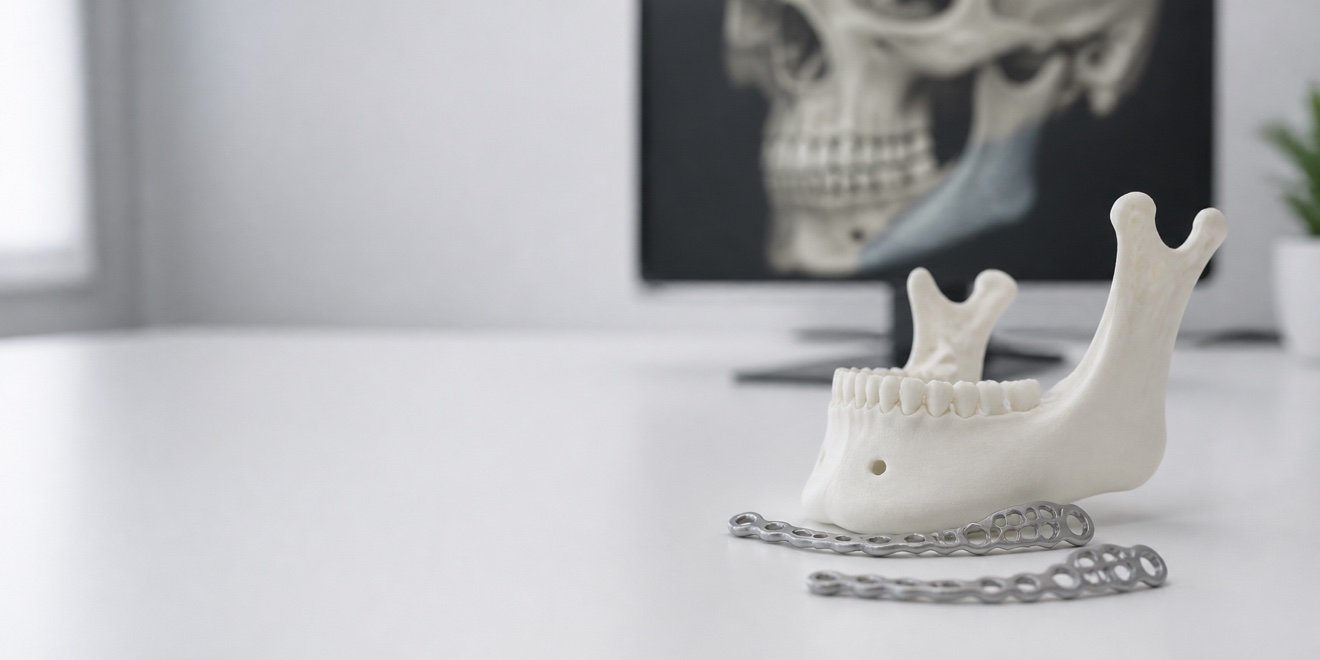
If your bite is unaffected and the asymmetry comes from missing bone, CT-designed, 3D-printed custom titanium implants are one option. In Assoc. Prof. Dr. Yalçın Bayram's 8-patient study, each side had its own implant; 5 patients had fat grafting. With standard facial implants, most people resume social life within 1–2 weeks; the final contour usually settles in 3–6 months.
What causes an uneven jaw?
Jaw asymmetry (mandibular asymmetry) means the two halves of the lower jaw differ noticeably in size, shape or position; the main causes are developmental differences present from birth and previous injuries.
- Congenital: a well-known example is hemifacial microsomia, where one half of the face is underdeveloped. A review describes it as the second most frequent congenital deformity of the skull and face, often with a short lower jaw, ear malformation and missing soft tissue.
- After trauma: jaw fractures can make the bone heal or grow differently on one side.
- Other causes: jaw joint (temporomandibular joint) problems, continued bone growth on one side or previous surgery.
The asymmetry may come from bone, soft tissue or both. The right treatment depends largely on this, and on whether your bite (how the teeth meet) is affected.
Why treat both sides when only one side looks smaller?
When one side of the lower jaw is underdeveloped (unilateral mandibular hypoplasia), the other half is affected too, so the study by Assoc. Prof. Dr. Yalçın Bayram and colleagues planned the correction on both sides. Because the lower jaw is a single bone, a shortfall on one side can shift the chin and midline, so the side that looks normal may not be where it should be. Each side therefore received its own custom titanium implant with a different shape; the paper presents this as a new bilateral, asymmetric CAD/CAM (computer-aided design and manufacturing) implant design.
How is a custom 3D jaw implant designed and placed?
A custom jaw implant is designed from your own CT scan, 3D printed and placed on the surface of the bone (an onlay implant). The pathway described in the paper:
- Consultation and CT scan: the source of the asymmetry is assessed and a thin-slice CT scan is taken.
- Virtual planning: in medical imaging software (Mimics), the unaffected half of the jaw is moved to the midline using the jaw joint as the pivot, and its mirror image creates the other side.
- Design and production: the difference between the corrected model and your current bone gives the shape of two implants, which are 3D printed in titanium. The paper states that this is time-consuming and costly.
- Surgery: performed in hospital. In the study, the implants were placed through an incision outside the mouth, and fat grafting (moving your own fat) refined the contour where needed.
- Recovery: study patients were followed for at least 12 months; the paper does not report recovery times. As general information for standard facial implants, most patients return to social life within 1–2 weeks and the final contour usually settles in 3–6 months; more extensive surgery can take longer.
What did the study find?
The authors were affiliated with the Department of Plastic and Reconstructive Surgery of Gülhane Military Medical Academy (GATA) in Ankara, and Assoc. Prof. Dr. Yalçın Bayram is the first author.
- Eight male patients were treated: five had asymmetry from birth and three after trauma.
- All came through surgery without early complications.
- Fat grafting was used in five patients, four of whom had hemifacial microsomia.
- At 12 months, scores on the Appearance Evaluation Subscale (AES) and the Rosenberg Self-Esteem Scale had improved significantly, and the Facial Asymmetry Index (FAI) showed a significant reduction.
This is a small case series: few patients, all men, compared before and after surgery rather than against another method. It cannot show that everyone will get the same result or that this method outperforms others.
Custom jaw implant vs standard implant, fat grafting or jaw surgery
The right option depends on whether the asymmetry is in bone or soft tissue, how marked it is and whether your bite is affected; no single method suits everyone.
| Option | Usually considered for | Limitations |
|---|---|---|
| Standard (off-the-shelf) implant, e.g. silicone or Medpor | Mild to moderate, fairly regular chin or jawline deficiency. | Set shapes may not match complex differences between the two sides. |
| Custom 3D implant | Marked, irregular bone deficiency in adults whose growth is complete and whose bite needs no separate treatment. | Takes time and is costly; most patients also need soft tissue adjustment; does not change the bite. |
| Fat grafting or filler | Mild asymmetry, soft tissue deficiency, fine-tuning after an implant. | Limited for large bone deficiency; some fat may be absorbed; hyaluronic acid filler is temporary. |
| Genioplasty (repositioning the chin bone) | Asymmetry or retrusion mainly at the chin, with a bite that needs no separate treatment. | Corrects only the chin, not the jaw angle or body; it is bone surgery and can cause lower lip and chin numbness. |
| Orthognathic (jaw) surgery | Asymmetry combined with a bite problem. | A more extensive pathway with orthodontics; contouring may still be needed afterwards. |
According to the same review, severe hemifacial microsomia may need several operations, such as jaw distraction (gradual bone lengthening), rib cartilage grafts, orthodontic and orthognathic treatment and soft tissue reconstruction.
For standard implant types, see the facial implant page and facial implants vs fillers; for the soft tissue side, read fat grafting vs fillers and the facial fat injection page.
What are the risks of a custom jaw implant?
A custom jaw implant is surgery and carries surgical risks, which should be discussed openly at consultation.
- Infection: may need antibiotics and, rarely, removal of the implant.
- Shifting or palpable edges: the implant can move, and its edges may be felt where soft tissue is thin.
- Nerve effects: an incision outside the mouth can affect the facial nerve branch that moves the lower lip, and the lower lip and chin may feel numb; this is usually temporary.
- Bleeding or fluid collection (haematoma, seroma), sometimes needing drainage.
- Scarring: the skin incision leaves a scar that fades but can thicken in some people.
- Remaining asymmetry: soft tissue differences can persist and may need further fat grafting.
A 2026 systematic review pooling 29 studies (392 patients) found low complication rates for custom titanium and PEEK (polyetheretherketone, a durable medical-grade plastic) facial implants: overall 6.94% for PEEK and 4.77% for titanium, with infection in 1.51% and 0.33%, and no clearly superior material, although most implants in the review were PEEK and titanium data were limited. The studies were small and varied, so these figures do not replace an individual risk assessment.
Who is not a good candidate?
- Children and teenagers whose facial skeleton is still growing.
- People whose asymmetry comes with a clear bite problem; an onlay implant does not correct the bite.
- People whose cause is not yet diagnosed, such as continued growth on one side, jaw joint disease or a suspected bone lesion.
- People with an active infection in the mouth or surgical area, uncontrolled diabetes, or heart or lung disease that rules out surgery.
- Smokers who cannot stop around surgery.
- Anyone expecting perfect, mirror-image symmetry; the aim is better balance.
Seeing a surgeon about jaw asymmetry from abroad
If you are travelling for treatment, ask before booking what is causing your asymmetry, whether your bite needs orthodontic or jaw surgery assessment, and what follow-up you will need at home. If a custom implant is considered, the CT scan, virtual planning, design and production add time before surgery can be scheduled, which affects when you can travel. The international patients page explains the general process for travelling patients, including flying home only after the surgeon's postoperative assessment.
Assoc. Prof. Dr. Yalçın Bayram's approach
In the study first-authored by Assoc. Prof. Dr. Yalçın Bayram, a specialist in Plastic, Reconstructive and Aesthetic Surgery, both sides were planned together and the target shape was taken from the mirror image of the healthy side. The authors stated that most patients also needed soft tissue adjustment, and results were tracked both with a measurement (FAI) and with patient questionnaires (AES, Rosenberg). Separately, the site's facial implant page describes planning the size, shape and position of standard implants with 3D simulation.
At consultation, the surgeon assesses whether the asymmetry comes from bone or soft tissue and whether your bite is affected; if there is a bite problem, orthodontic and jaw surgery assessment is recommended. Results vary from person to person. Read about his background on the about us page or request a consultation.
Frequently Asked Questions
Can jaw asymmetry be fixed without jaw surgery?
If your bite is not affected and the problem is mainly missing bone or soft tissue, an onlay implant, fat grafting or filler may be considered without moving the jaw bones. If there is also a bite problem, orthognathic surgery with orthodontics is usually assessed.
What is the difference between a custom jaw implant and a standard one?
Standard implants come in set sizes and can be trimmed during surgery. A custom implant is designed from your CT scan, so it can match bone deficiencies that differ between the two sides.
How long does it take to make a custom jaw implant?
Scanning, planning, design and 3D printing all take time, and the paper describes the process as time-consuming. If a custom implant is considered, surgery can only be scheduled once design and production are complete, so anyone travelling should allow for this.
Will I still need fat grafting after a custom implant?
Often, yes. In the study, five of eight patients had fat grafting to refine the contour, and the authors note that most patients needed soft tissue adjustment.
Is a custom jaw implant only for men?
All eight patients in the study were men, so it does not report results for women. Suitability depends on the cause and degree of the asymmetry and is assessed at consultation.
References
- Bayram Y, Zor F, Kilic S, Acikel CH, Kulahci Y, Cordes E. Correction of Mandibular Asymmetry With Bilateral Asymmetric Custom-Made 3D Implant. J Craniofac Surg. 2026 (online ahead of print). doi:10.1097/SCS.0000000000012368. PMID: 41499545
- Steengaard RK, Ørholt M, Herly M, Vester-Glowinski PV, Kofod T. Complications After Patient-specific Implants for Facial Contouring and Augmentation: A Systematic Review and Meta-analysis. Plast Reconstr Surg Glob Open. 2026;14(7):e7911. doi:10.1097/GOX.0000000000007911. PMID: 42559491
- Luo S, Sun H, Bian Q, Liu Z, Wang X. The etiology, clinical features, and treatment options of hemifacial microsomia. Oral Dis. 2023;29(6):2449-2462. doi:10.1111/odi.14508. PMID: 36648381
Last reviewed: October 2026
Medical review: This article has been medically reviewed by Assoc. Prof. Dr. Yalçın Bayram, specialist in plastic, reconstructive and aesthetic surgery (Şişli, Istanbul). For his background and academic publications, see about us. This article is for general information; the right approach for you is decided at consultation.
