
Will a Facelift Leave a Scar? Incision Sites, Scar Care and What Affects Visibility

Yes, a facelift leaves a scar; every surgical incision leaves a permanent scar. Because the incisions are usually placed in the crease in front of the ear, around the earlobe, behind the ear and within the hair-bearing scalp, in most patients the scar fades over time to a fine, pale line that is not very noticeable. How visible the scar is depends on factors such as closure tension, skin type, smoking and aftercare, and varies from person to person.
Will a facelift leave a scar?
Yes, a facelift leaves a scar; every surgical incision in the skin leaves a permanent scar as it heals. The aim is not to make the scar disappear, but to make it as inconspicuous as possible by placing the incision in natural creases and within the hair-bearing scalp, and by closing the tissue without tension.
In most patients, once healing is complete, the scar becomes a fine, pale line that is hard to pick out in everyday life unless someone looks closely. However, how the scar will look depends on your skin structure, genetic tendency and healing process. For this reason, nobody can say in advance exactly how a scar will look.
Where are facelift scars?
Facelift incisions usually begin at the temple, in front of the sideburn, along the hairline; they run down the crease in front of the ear, go around the earlobe to the back of the ear and from there extend to the hairline at the nape of the neck. The exact path of the incision varies with the technique used and the structure of the patient’s face.
- Temple area: The incision is mostly planned within the hair-bearing scalp or along the hairline.
- In front of the ear: The incision runs along the crease in front of the cartilage of the small projection at the ear opening (the tragus), or just behind that cartilage.
- Around the earlobe: It follows the natural line where the earlobe joins the face.
- Behind the ear and along the nape hairline: It passes from the crease behind the ear to the nape hairline and runs down along the hairline.
- Under the chin: If the neck is also being treated, a short incision a few centimetres long may be added just behind the natural crease under the chin; for details, see our article Can a facelift and neck lift be done together?
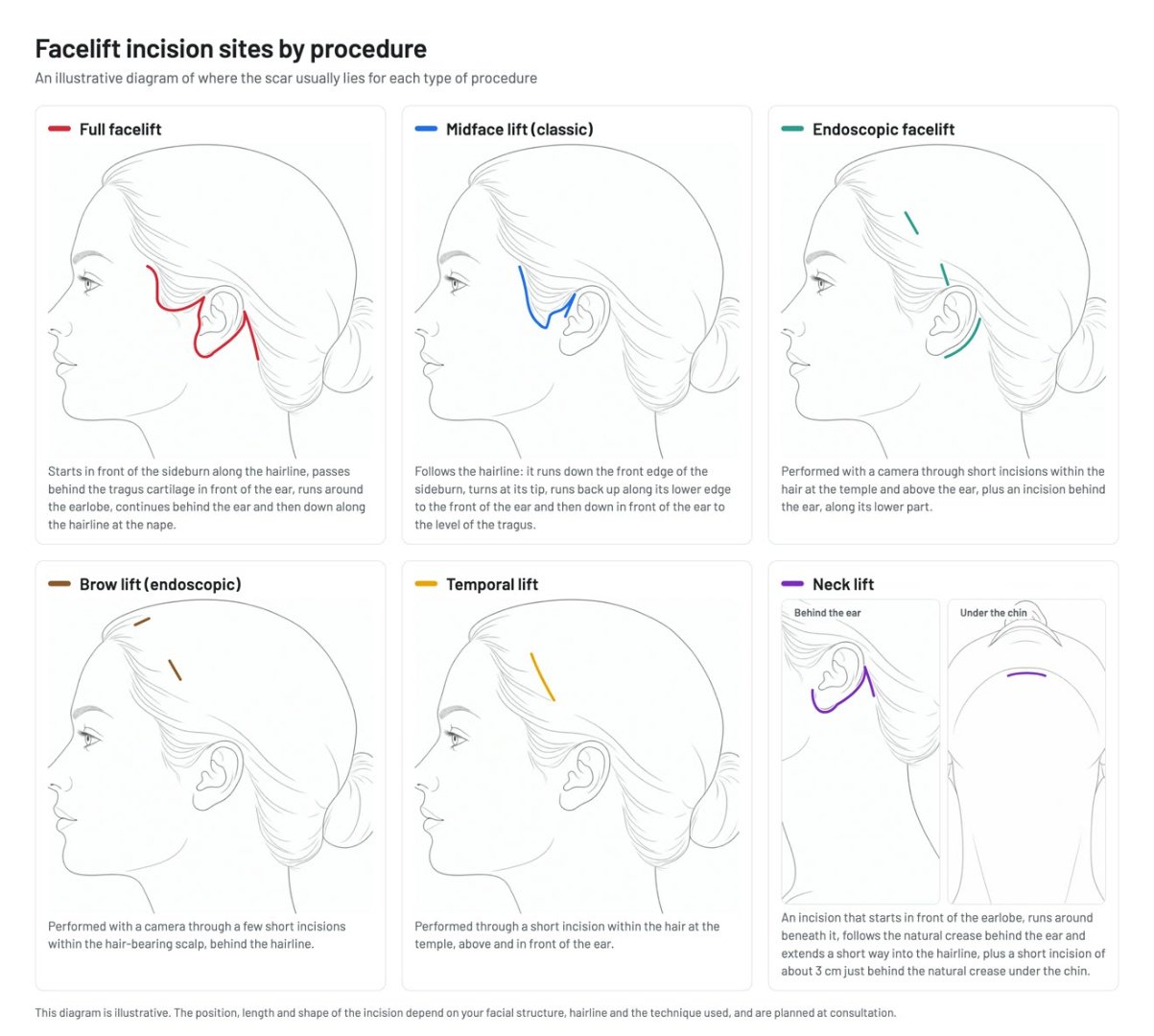
With short-incision facelift approaches, the incision can be kept shorter; however, the degree of sagging these approaches can correct is also more limited. Whether the incision in front of the ear runs behind or in front of the tragus cartilage is planned at consultation, based on features such as skin thickness, ear structure and, in men, the beard line.
How are facelift scars hidden?
How inconspicuous the scar is depends largely on the planning and closure technique during surgery. The main principles are:
- Natural shadows and creases: The incision is placed where shadows already fall, such as the folds of the ear and the hairline.
- Preserving the hairline: At the temple and the nape, the incision is planned so that it does not create a step in the hairline.
- Placing tension on the deeper tissue: When the lift is done through the underlying support layer (the SMAS) rather than the skin, the skin edges can be closed without tension. In wounds closed under tension, the scar is more likely to widen. How different techniques approach this is explained in our comparison of deep plane and SMAS facelifts.
- Layered, careful stitching: The deep stitches carry the load; the surface stitches only align the skin edges.
For the overall course of the operation, see our guide to facelift surgery and the facelift page.
What affects how visible the scar is?
Scars can look different in two people operated on with the same technique, because personal factors shape scar formation as much as the surgery does.
| Factor | Effect on the scar | What can be done? |
|---|---|---|
| Closure tension | In wounds closed under tension, the scar may widen and thicken | Lifting through the deeper tissues; tension-free closure |
| Skin type and genetics | Thick scars or colour changes are more common in people with darker skin and those with a family tendency to thick scarring | Assessment of previous surgical and wound scars at consultation |
| Smoking | Reduces blood flow to the skin; wound healing may be delayed, and the risk of skin circulation problems and a noticeable scar increases | Stopping smoking ahead of surgery and during the post-operative period |
| Sun | A new scar can darken in the sun, and a permanent colour difference may develop | Sun protection and a high-factor sunscreen in the first months |
| Infection, haematoma (a collection of blood) | Can make the scar more noticeable by disrupting wound healing | Attending check-ups regularly and following the recommended aftercare |
| Aftercare | Regular scar care may support scar maturation | The scar care programme recommended by your doctor |
Smokers are usually asked to stop smoking at least 2–4 weeks before surgery and not to smoke throughout the recovery period; other nicotine-containing products are treated in the same way. The right period for you is decided at consultation.
How does a facelift scar change over time?
In the first weeks, a facelift scar may be pinkish-red and slightly raised; over time it fades, flattens and becomes finer. Scar maturation is usually complete within 12 months; in some patients whose wound healing follows a different course, with an excessive tissue response, this can take up to 18 months. The final appearance of the face usually settles within 3–6 months, whereas the incision scar takes longer to mature. The timeline below is a general framework; the details vary according to your doctor’s advice.
- First 10 days: The wound line is kept clean and dry, and the dressing recommended by your doctor is applied. Dissolvable stitches are usually used; if non-dissolvable stitches have been used, they are usually removed around day 10.
- Weeks 2–6: Once the wound has fully closed, scar care products such as silicone gel or cream can be started if your doctor recommends them. During this period the scar may look pink and noticeable; this is normal.
- Months 2–6: The colour of the scar gradually fades. Sun protection continues during this period. If you notice thickening or itching, it is important to come in for a check-up.
- Months 6–12 (up to month 18 in some patients): The scar matures; in most patients it becomes a fine, pale line. The final assessment of how the scar looks is usually made after this period.
If you are travelling to Istanbul, plan the length of your stay around your first check-ups and, if non-dissolvable stitches are used, their removal, and ask in advance how follow-up will be arranged once you are home.
Scar care usually begins once the wound has fully closed and is supported by sun protection. Silicone gel or tape may be used depending on your scar history from previous operations and on your doctor’s advice. The preventive effect of silicone products has mainly been shown in patients prone to thick (hypertrophic) scars; there is no strong scientific evidence that they markedly improve the scar in a wound that is healing normally. Because tape is difficult to apply to the face, silicone gel or cream is usually preferred; if you would like to use it, you can do so with your doctor’s approval.
Is there a risk of hypertrophic scars and keloids?
Yes, there is a risk, although it is low. Hypertrophic scars (raised, thick scars that stay within the boundaries of the wound) can occur after a facelift, most often in the area behind the ear. Keloids (scars that grow beyond the boundaries of the wound) are less common on the face; however, the risk is higher in people with a personal or family history of keloids.
Hypertrophic scars can often be treated. The options include silicone treatments, cortisone (steroid) injections into the scar, some laser treatments and, when needed, surgical correction of the scar (scar revision). Keloids, by contrast, are harder to treat, and treatment is often unsuccessful. For this reason, if you developed thick scars or keloids after previous operations, it is essential to mention this at consultation.
What are the risks of a facelift other than scarring?
The main risks of a facelift are haematoma (a collection of blood under the skin), infection, temporarily reduced sensation, weakness in branches of the facial nerve (mostly temporary), skin circulation problems, asymmetry and changes to the hairline. Serious complications are uncommon; however, as with any surgery, the risks are not zero. Results vary from person to person, and which technique is suitable is decided at consultation.
What is discussed about scarring at consultation?
At the pre-operative consultation, scarring is discussed together with the incision plan and your personal risk factors. The following topics are usually assessed:
- How previous surgical and wound scars have healed; any personal or family history of thick scars or keloids
- Skin type, skin thickness and sun exposure habits
- The position of the hairline and hair length; how the incision will be planned within the hair
- Smoking, nicotine products, and any medicines or conditions that may affect wound healing
- That the scar is permanent, that it takes months to mature and that its final appearance varies from person to person
This assessment helps plan the incision according to your facial structure and set realistic expectations about scarring.
To discuss an incision plan suited to your own facial structure, you can book an appointment via the contact page.
Frequently Asked Questions
Is a facelift scar permanent?
Yes, a surgical incision scar is permanent; however, it becomes markedly finer and paler over time. In most patients, once it has matured, the scar remains as a fine line within natural creases and the hair. The final appearance of the scar usually becomes clear within 12 months, and up to 18 months in some patients.
Will my hair cover the facelift scar?
Because the temple and behind-the-ear sections of the incision are mostly planned within the hair-bearing scalp or along the hairline, they are largely covered by hair. The section in front of the ear is placed in the natural folds of the ear. If your hair is short or your hairline is receding, the incision plan is adapted accordingly.
Why can the scar behind the ear be more noticeable?
The area behind the ear and at the nape is stretched more by neck movements. For this reason, the likelihood of the scar thickening or widening here is somewhat higher than in other areas of the face. Scars of this kind can mostly be treated with methods such as silicone treatment or injections into the scar.
When can I wear make-up over a facelift scar?
Applying make-up to the scar line is not recommended before the wound has fully closed and, if there are stitches to be removed, before they have been taken out. Concealing make-up can usually be used once the wound has closed, with your doctor’s approval. Because the timing varies from person to person, ask your doctor at your check-up.
Can a poor facelift scar be improved?
Yes, there are various treatment options for noticeable or thick scars. Silicone products, cortisone injections, laser treatments and, when needed, surgical scar revision can be used. Revision is usually considered once the scar has fully matured. With keloids, however, treatment is harder and may not be successful.
Medical review: This article has been medically reviewed by Assoc. Prof. Dr. Yalçın Bayram, specialist in plastic, reconstructive and aesthetic surgery (Şişli, Istanbul). For his background and academic publications, see about us. This article is for general information; the right approach for you is decided at consultation.
